Introduction
Across the United States, local governments — cities and counties alike — have spent generations wrestling with a stubborn, multidimensional challenge: vacant and at‑risk properties.
These parcels don’t just sit empty. They:
- Depress surrounding home values
- Drain property, income, and sales tax revenue
- Increase code enforcement and public safety costs
- Drive up neighborhood complaints
- Reduce quality of life
- Fracture intergenerational wealth for families
In many regions, especially post‑industrial and legacy markets like the Midwest, the problem is deepened by long cycles of vacancy and abandonment. But that story — and the way governments have responded — has evolved. What was once a crisis is now being reframed as an opportunity for innovation, revenue protection, and community strengthening.
This guide tells that full story — from where vacancy policy began to where it must go next.
A Century of Problem‑Solving: Traditional Responses to Vacancy
Code Enforcement — The First Line of Defense
Dating back to the early 20th century, local governments began to adopt building codes, health codes, and nuisance laws to protect residents and properties.
These rules required:
- Minimum maintenance standards
- Safe structures
- Clean lots
- Functional utilities
The function of code enforcement was, and still is, to protect the community from blight and danger. Local residents generally view this work as important.
The Limitation: Code enforcement doesn’t act until a property crosses a threshold — visible deterioration, safety violations, or a resident complaint. That means the problem has already happened.
A 2014 HUD report on urban blight found that code enforcement responds to symptoms after they appear, rather than stopping the underlying causes.
Land Banking — Taking Control After Default
Land banks began to take shape in the late 20th century as a way for governments to take possession of vacant, abandoned, or tax‑delinquent properties and shepherd them back into productive use.
At first, land banks were passive — they held properties to avoid harm. By the 2000s, especially after the Great Recession, they became more active tools for:
- Clearing titles
- Stabilizing land for redevelopment
- Transferring properties to productive users
Brookings documented how land banks were heralded as a core response to post‑2008 vacancy, especially in markets like Detroit and Cleveland.
The Limitation: Land banks only gain control after vacancy or foreclosure has occurred. They are a downstream solution.
Vacant Property Registries — Seeing What Was Hidden
In the early 2000s, many local governments adopted vacant property registries — ordinances requiring owners to register empty properties and pay fees.
These registries helped governments:
- Track vacant parcels
- Hold owners accountable
- Fund monitoring and inspections
The Limitation: Registries improve data but still don’t prevent vacancy or reveal the risk before it happens.
Vacancy Today: A Structural, Widespread Issue
Vacant properties have never been only about one empty house. They are a structural phenomenon influenced by:
The 2008 Financial Crisis
Millions of foreclosures flooded markets with vacant homes. Some studies by the Federal Reserve found that entire neighborhoods were affected, with spillover effects on property values and local tax bases.
The Federal Reserve’s work on foreclosed and vacant properties highlighted how traditional tools trapped cities in reactive cycles that couldn’t keep up with the pace of vacancy.
Investor Buying Trends
More recently, investor activity — both small and institutional — has reshaped housing markets.
In many areas, researchers have documented 30% or more investor share of purchases, especially in the post‑pandemic market. Brookings and other housing experts have pointed out that this pressurizes affordability and squeezes owner‑occupancy opportunities.
The Turning Point: Predict, Don’t Just React
Most local tools — code enforcement, land banks, registries — wait for the alarm to ring.
What if you could see the alarm coming?
Rather than responding to a property once it is visibly empty or in violation, what if you could detect the risk of vacancy months or years before it manifests?
That’s the frontier of modern vacancy strategy: prediction combined with action.
The Virtual Land Bank Platform: Prediction at Scale
The Virtual Land Bank Platform (VLBP) is built around a core capability:
- To identify properties that are likely to become vacant before they actually do, and then help local governments prevent that vacancy.
To do this, the VLBP uses data — everything from probate records and divorce filings, to loan performance, tax history, and ownership patterns — and turns it into a risk signal.
This lets local governments see:
- Which properties are heading for distress
- Why they are at risk
- What kind of intervention could stabilize them
Then the platform triggers workflows to resolve issues early — before the property ever sits empty.
Built for Big Investors. Rebuilt for Local Governments.
In 2022, this same capability was redesigned to support Blackstone’s Home Partners of America — a large institutional buyer planning to acquire up to 12,000 homes per year.
That version of the system could have amplified investor buying in markets already tight on affordable inventory. Instead, leadership chose to pivot.
With the support of Google’s in‑house engineering team, the platform was rebuilt to serve local governments — enhancing prediction, enabling early intervention, and routing troubled properties to responsible outcomes that keep homes in local hands.
Proof on the Ground: The Cuyahoga County Initiative
This shift isn’t theoretical. It’s proven.
Between 2018 and 2025, Parcel Revenue led a groundbreaking pilot with current and retired local government leaders across agencies in Cuyahoga County.
The challenge: 7,700 vacant and at‑risk properties, many tied up in complicated legal scenarios.
The results were striking:
- 📍 1,500 distressed property owners engaged — most with properties impacted by foreclosure or probate
- 🏠 Over 85% of identified at‑risk properties were sold to owner‑occupants
- 💰 Most transactions used FHA financing, enabling affordable ownership
- 💸 Average occupancy restoration cost—~$150,000 per unit, far below typical new construction costs of $232,000–$600,000+
- 🏛 100% approval rating in Cuyahoga County Probate Court
- ⚖ 93% success in loan modifications and foreclosure dismissals in Cuyahoga County Common Pleas Court
- ✅ Zero title insurance claims — indicating sound legal and transactional integrity
Why This Matters — Economically and Politically
For Local Tax Bases
Vacancy costs money. Once a home sits vacant, nearby property values drop — dragging down tax revenues for years. Prediction helps governments halt revenue loss before it starts.
For Neighborhood Stability
Vacant houses affect community perception as much as they affect economics. Early resolution strengthens pride, increases occupancy, and improves safety.
For Constituents
Residents don’t want reports — they want results. When a neighborhood stabilizes, political capital rises.
What Makes Prediction Different
Traditional strategies were built for:
- Response
- Cleanup
- After‑the‑fact solutions
Prediction adds:
- Timeliness — early detection before effects become visible
- Precision — data‑driven prioritization
- Outcome‑focus — targeted workflows, not generic compliance
- Prevention — not just reaction
From Crisis to Opportunity
Vacancy used to be a problem local governments endured. Now it’s a strategy you can solve. Prediction transforms what was once a burden into a new engine of stability, equity, and growth.
Ready to Act? Your Next Step Starts Now
With the right technology, you can:
- ✅ Predict which properties are at risk
- ✅ Intervene before vacancies appear
- ✅ Protect your neighborhoods and your residents
- ✅ Grow your tax base without raising taxes
📥 Download the Free Lead Magnet
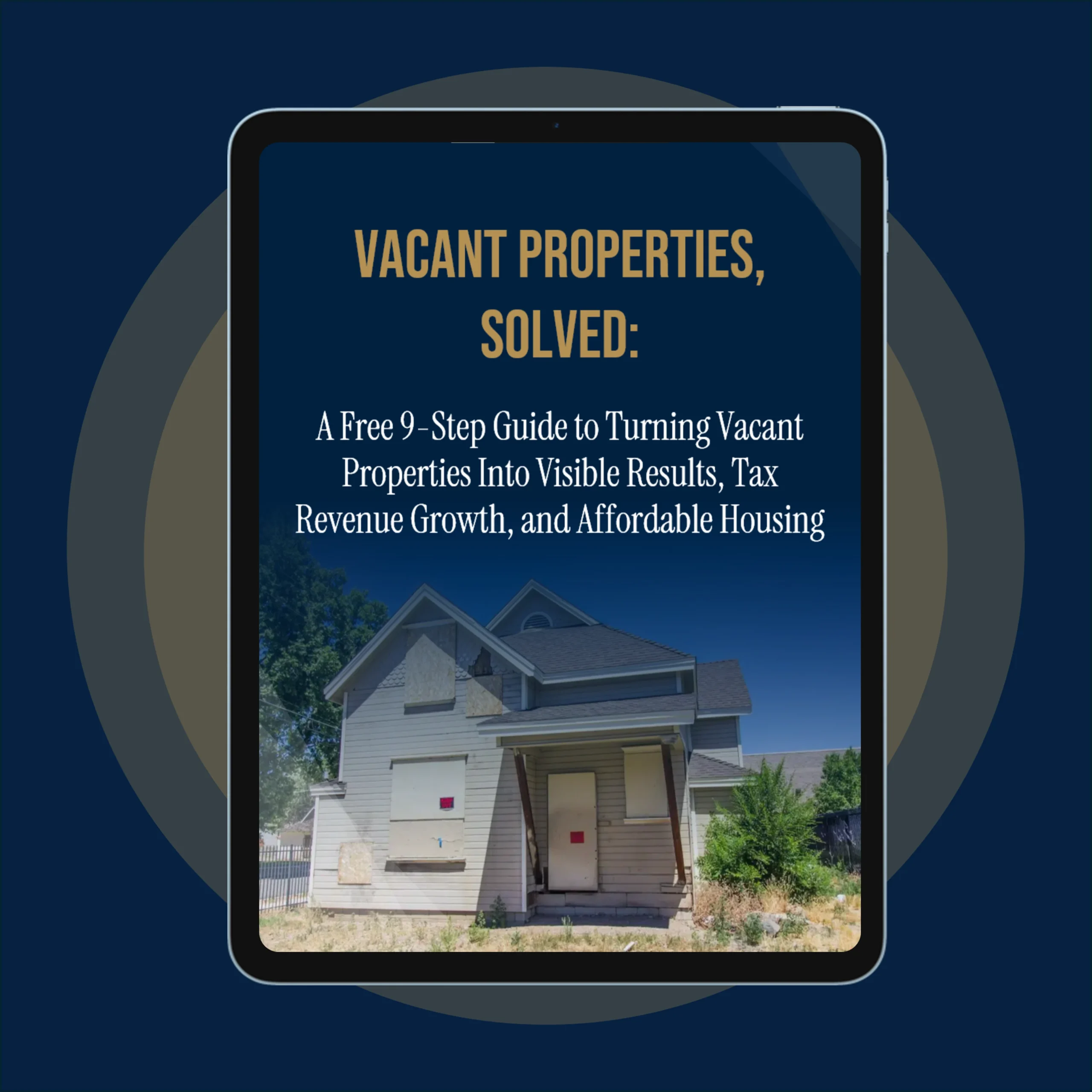
“Vacant Properties, Solved: A 9-Step Guide to Turning Vacant Parcels Into Visible Results, Revenue Growth, and Affordable Housing”
Get practical steps, legal frameworks, and engagement models — straight from the playbook used in the 7,700-parcel pilot.
📞 Talk to a Vacancy Strategy Expert
Let’s talk about your vacant parcel data, your top challenges, and your vision for neighborhood revitalization.
Get a tailored walkthrough of how the Virtual Land Bank Platform works and what it can do for your community.