How cities turn economic signals and parcel-level data into credible funding conversations with counties and grantors.
City leaders don’t struggle because they lack need.
They struggle because they lack proof.
When cities approach counties, regional partners, or grantors, the real question isn’t whether investment is justified — it’s whether decision-makers can see clear evidence that funding will produce measurable outcomes.
That’s where sales-tax trends matter — not as city revenue, but as an economic signal — and where actionable vacancy data becomes decisive.
Counties and grantors track sales-tax trends closely because they reveal consumer confidence, business durability, corridor performance, and regional economic momentum. Sales tax reacts faster than property values or long-term income data. When it softens or becomes uneven, counties know something is breaking beneath the surface.
What they look for next is simple: which cities are acting early, and which ones are reacting late.
The challenge for most cities is not identifying vacancy. It’s demonstrating which properties matter most, which corridors are at risk, what actions are feasible now, and how quickly results can be achieved. Without that clarity, funding requests sound like remediation, not investment.
Sales-tax trends provide context. They help cities frame vacancy as an upstream economic risk, a regional concern, and a preventable cost. But context alone isn’t enough. Counties don’t fund narratives. They fund execution confidence.
That’s where Parcel Revenue’s Virtual Land Bank Platform (VLBP) comes in.
VLBP helps local governments transform vacant properties into sustainable income, sales, and property-tax revenue growth by converting fragmented vacancy data into a prioritized, defensible action pipeline. It moves cities beyond lists and dashboards and into parcel-level decision-making that can be explained, defended, and measured.
With VLBP, cities can identify which parcels pose the greatest fiscal and corridor risk, prioritize action based on real-world constraints, assign clear next steps by property, and track outcomes that translate to ROI and risk reduction. This isn’t a reporting tool. It’s an operating system for moving properties from vacancy to productive use.
Because the VLBP workflow and decision framework are patent pending, this capability can’t be replicated by stitching together spreadsheets, consultants, and generic software. It gives cities something counties and grantors rarely see: credible proof of execution readiness.
Cities using VLBP don’t walk into county meetings asking for help. They walk in with a prioritized parcel pipeline, corridor-level risk visibility, a clear execution plan, and outcome metrics that can be monitored over time. Sales-tax trends establish the economic signal. VLBP supplies the proof that investment here is lower-risk and higher-confidence.
Counties and grantors consistently invest more in cities that demonstrate economic momentum, return on prior public dollars, active and stable corridors, and measurable vacancy reduction. VLBP gives cities a way to document all four before decline becomes expensive.
Sales-tax trends show counties where the economy is headed. Vacancy shows them where it may fail. Cities that connect the two using actionable data become safer investments.
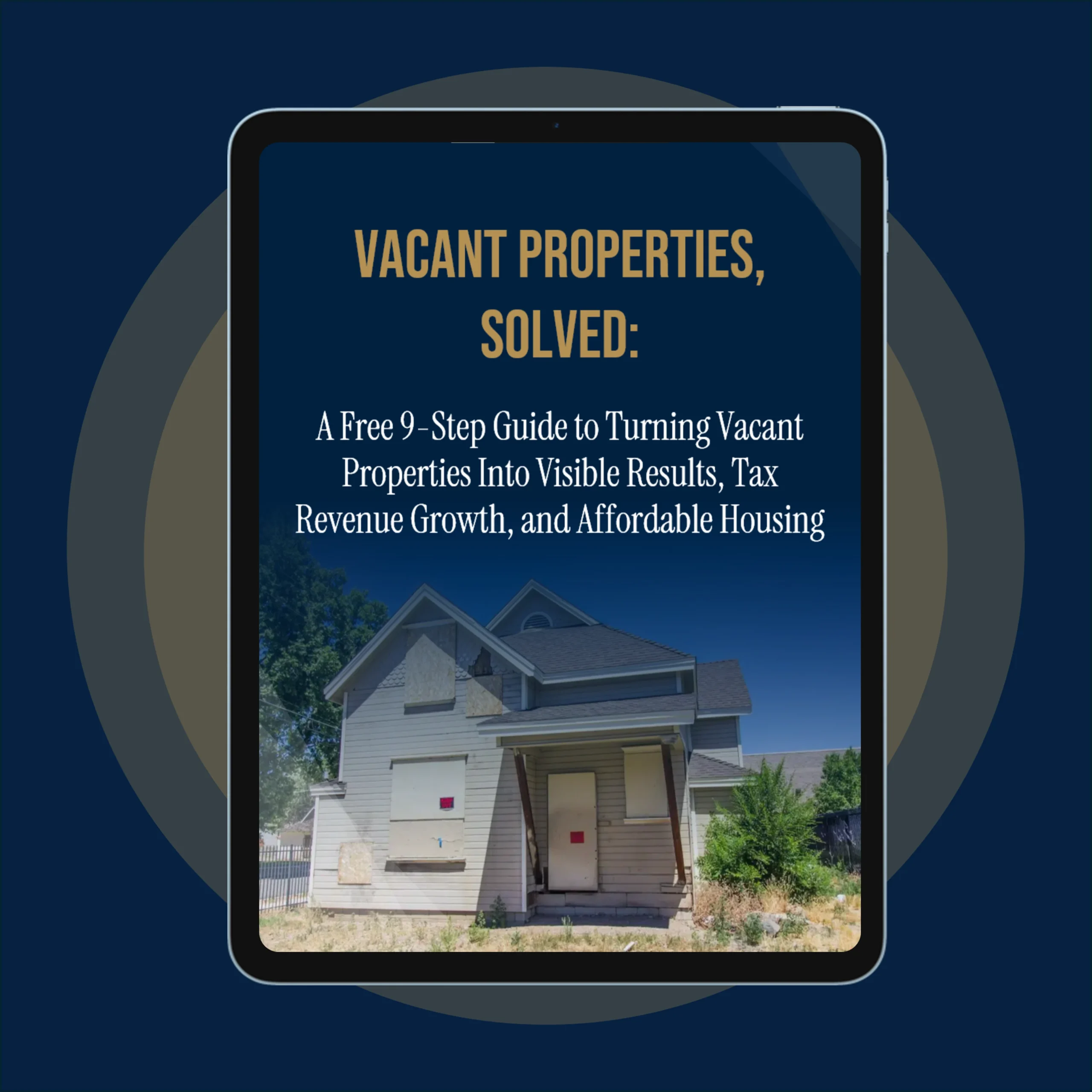
If you want to see how cities are turning vacancy into visible results, strengthening their investment case with counties and grantors, and stabilizing income, sales, and property-tax revenue without adding staff or managing another system, download Vacant Properties, Solved: A Free 9-Step Guide to Turning Vacant Properties Into Visible Results, Tax Revenue Growth, and Affordable Housing, or talk to an expert about applying VLBP to your city.