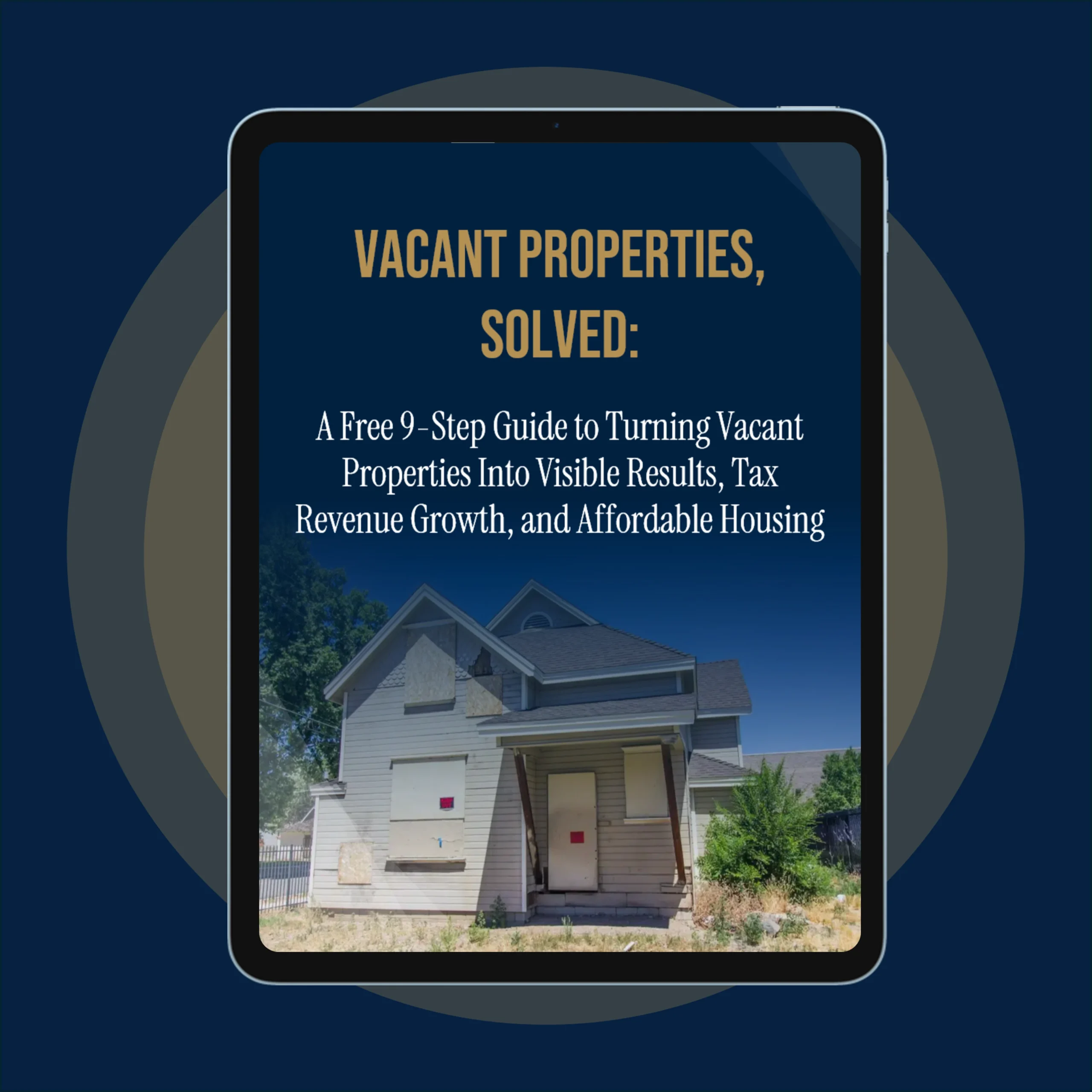
Fewer Vacancies = Happier Residents & Higher Property Values
We are now accepting applications from forward-thinking local governments to pilot the Virtual Land Bank Platform™.
- Municipal pilot program by application only
- 1–3 year pilots with preferred early adopter terms
- Limited number of pilot cities
- Built by Google’s in-house engineers on the high-security Google Cloud Platform
Fewer Vacancies. Happier Residents. Stronger Property Values.
60-Day Trial • No Commitment • First Payment Deferred Up to One Year
Explore the platform, see how it works in your city, and decide later—without budget pressure or political risk.

Community Edition ($0 Monthly)
- Identify distressed properties faster
- Prevent abandonment with automated, staff-guided tools
- Protect property values through early intervention
- Uses your existing outreach tools and staff follow-up capacity
- $0 per month for life for up to 25 vacancies
- Includes access to all future system upgrades at no charge
- *Application and Pilot Project Advisory Board approval required
- One-time setup fee: $5,000 (training included)
Virtual Land Bank Platform™ by Parcel Revenue Corporation (Fully-Managed Edition for Local Governments Managing 25 to 25,000+ Vacancies)
- Proactively identify future vacancies before properties enter your registry
- Quickly Move stalled parcels out of registry limbo and back to productive use
- Prevent long-term blight through early, data-driven intervention
- Reduce repeat vacancy after ownership transfers and enforcement actions
- Deliver clear, data-driven results you can share with constituents
- Produce visible performance metrics for council, mayors, and public reporting
- Recover and grow income, sales, and property tax revenues tied to vacant parcels
- Available in the U.S., Canada, India, the U.K., and Australia
- *Application and Pilot Project Advisory Board approval required
We also offer Virtual Land Bank Platform™ Feasibility & Fiscal Impact Assessments that quantifies how much money vacancies are costing your local government/community and identifies the Platform configuration that best fits your budget, staffing, and policy/revenue goals.
Features
Real-time vacancy surveillance
One system to track and monitor both current vacancies and properties highly likely to become vacant in the next 1-7 years.
Tie vacancies to tax revenues
Save time and resources by knowing which code enforcement and land bank initiatives will bring in tax revenues immediately.
Customized notifications
Opt-in to important text and email notifications like when a home becomes abandoned near a school, park, or nursing home.
Eliminate "zombie" properties
Know when owner and/or lien holder behavior will result in a future extended "zombie" vacancy and be proactive - not reactive.
Outsource to save time
We handle skip tracing, tracking down LLC's and out-of-town investors who violate housing codes so you don't have to.
Organize all of government
Centralize property-specific details and communications across all levels of local government to increase efficiency.
Write better grant applications
Infuse grant applications with proprietary, data-driven insights to differentiate your community from other grant seekers.
Increase property values
Raise real estate values by laser focusing on distressed properties that adversely impact the value of neighboring properties.
Fight Investors and Speculators
Preserve limited housing stock for local families and owner-occupants to purchase before investors.
Provide detailed reports to courts
Make code enforcement more efficient by getting judges and magistrates on the same page to enforce local ordinances.
Collect more fines and fees
Watch revenues from court costs, fines and fees rise by deploying our proprietary MicroFines® technology.
Attract new businesses
Detailed reports empower economic and community development officials with the data to attract outside investment.
Frequently Asked Questions
Virtual Land Bank Platform™ by Parcel Revenue Corporation pricing depends on several factors including, but not limited to, the number of total parcels in a area, the number of parcels local government contracts with us to monitor, and the amount of income sales, and property tax revenues generated per parcel in your community. Exact pricing is only available after an initial consultation and feasibility study are completed. Turn-around-time is currently 2-3 weeks to receive a complete pricing proposal.
The Platform is optimized for both municipal and county/parish level governments. While there are hundreds of factors we consider, local governments who have already deployed a Vacant Property Registry and related local ordinance are best suited to see result quickly.
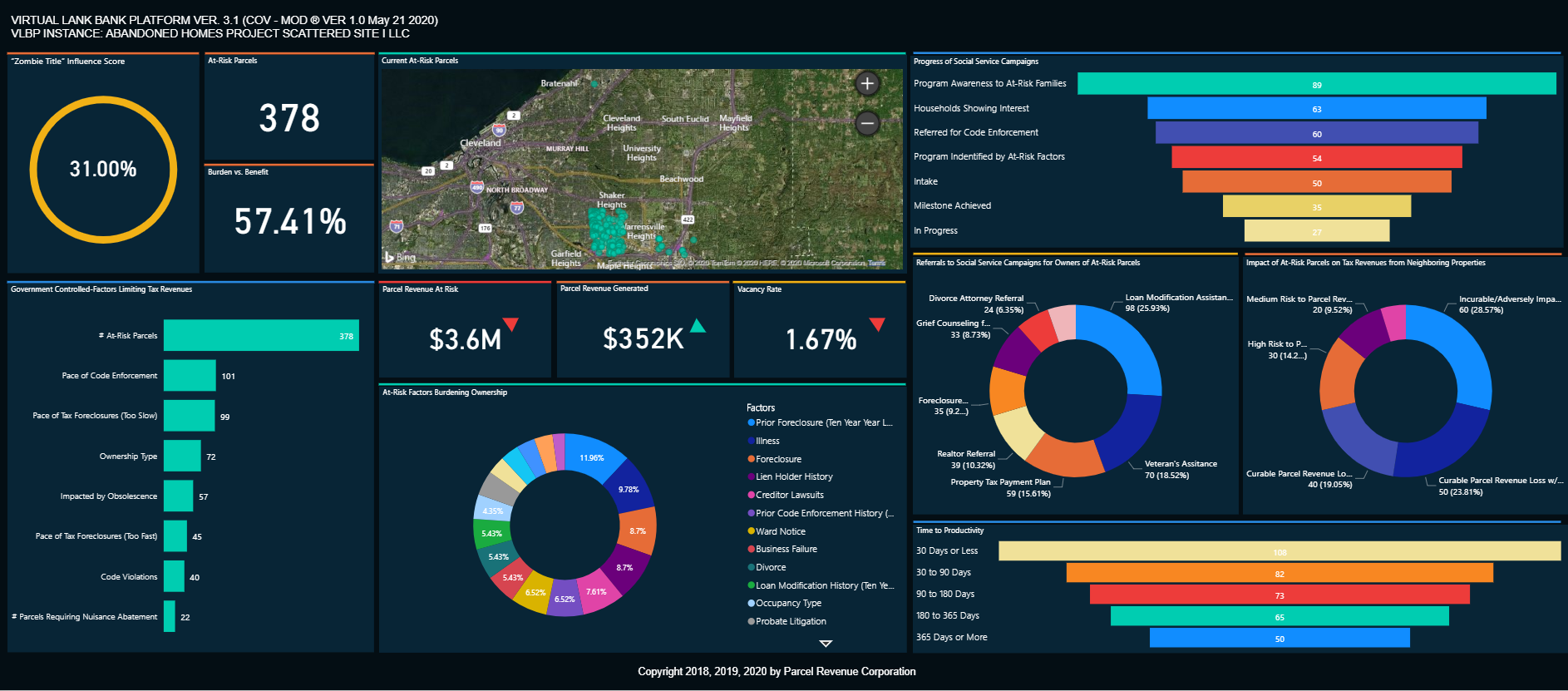
While there are 14 overall metrics and improved by the Platform, the main key metrics are Parcel Revenue At-Risk (tracks the amount of tax revenue at-risk due to distressed real estate in your community), Parcel Revenue generated (how much revenue has been generated/saved by the Platform), and Vacancy Rate (how many properties are vacant or at-risk of being vacant versus how many total properties are in your community).
Parcel Revenue is an algorithm that assumes every parcel of real estate in your community generates income, sales, and property taxes for your local governments. We conduct surveys of data specific to your community to determine how much Parcel Revenue each parcel should generate over the next 5 years. That number is then multiplied by the total number of vacant and at-risk properties in your community. This analysis also contemplates the Principle of Regression in real estate states that a higher-valued property will suffer a decrease in value if it is located in a neighborhood with lower-valued homes. This phenomenon occurs because the, superior property’s value is dragged down by surrounding, less desirable, or smaller properties.
Assuming the average parcel of land in a community generates $3000 in yearly income taxes, $4000 in yearly sales taxes, and $6000 in yearly property taxes, the total number of taxes generated ($13000) is multiplied by 5 to give us a Parcel Revenue number of $80,000.00. This tells us that for every property in your community that sits vacant for 5 years, $80,000.00 in tax dollars are lost. This formula also contemplates the Principle of Regression in real estate states that a higher-valued property will suffer a decrease in value if it is located in a neighborhood with lower-valued homes. This phenomenon occurs because the, superior property’s value is dragged down by surrounding, less desirable, or smaller properties.
Code enforcement and land banking are proven methods that, when properly deployed, get results. However, both are reactive which means properties must become poorly maintained and/or unproductive before these methods are triggered. The Platform is a predictive tool which can predict and prevent vacancies 1-7 years before property distress adversely impacts tax revenues and the community as a hole. Further, if the vacancy rate in your community rises faster than code enforcement and land banking can react to avoid unproductive real estate from accumulating, the backlog of vacant properties will overrun the community, causing extended “zombie” vacancies (long-term blight). This equates declining property values, population, and tax revenues for years to come.
The Platform boasts patent-pending technology called “Zombie” Title Influence Scoring which gathers data from public records and physical property inspections to determine when the legal and physical characteristics that cause extended “zombie” vacancies are adversely impacting the community and what steps must be taken to counter that negative impact.
Getting started begins with an application. Before applying, local governments may schedule a pre-application call to speak with one of our experts and review the program requirements. During this call, we will walk your team through the technical, staffing, and data requirements and help determine which Virtual Land Bank Platform™ program is the best fit for your organization. After you submit an application, our team will review it and invite a limited number of local governments to move forward.
If selected, we will gather the required data and present a clear proposal outlining the recommended platform, pilot structure, timeline, and costs.
The Platform guides code enforcement officials with data-driven insights that laser focus on the exact properties that adversely impact tax revenues and increase blight. Before and after code enforcement efforts are triggered, we handle all aspects of data collection and property owner engagement and counsel property owners to achieve milestones, such as property tax payment plans and mortgage loan modifications, via trained, licensed attorneys and real estate agents working with HUD-approved foreclosure counseling agencies. The result of this partnership is a drastic improvement in code enforcement efficiency and the ability to assist a large number of property owners without the need for government to hire, train, and compensate additional government employees. All property owners assisted are tracked and reported back to you and engagement only begins after property owners release your local government from any and all liability.
Data security and privacy are foundational to how the Virtual Land Bank Platform™ is designed and operated.
We work exclusively with local governments and understand that we are entrusted with sensitive constituent, property, and enforcement-related data. Our security program is built on Google Cloud’s enterprise infrastructure and aligned with the expectations of municipal IT, legal, and risk management teams.
Data Ownership and Control
All data remains the property of your local government.
We do not sell, license, or share your data with third parties.
Your organization retains full ownership and full control over how data is used and accessed.
Secure Google Cloud Infrastructure
The platform is hosted on Google Cloud’s enterprise-grade infrastructure, which provides:
Encryption of data at rest and in transit by default
Continuous infrastructure monitoring and threat detection
Network-level security controls and firewalls
Redundant systems for high availability and disaster recovery
Google Cloud’s security controls are used by governments, financial institutions, and critical infrastructure providers worldwide.
Access Controls and User Permissions
Access to the platform is role-based and permission-controlled.
Only authorized users from your organization can access your data
Administrative controls allow you to manage users, roles, and permissions
Multi-factor authentication and secure login practices are supported
Auditability and Activity Logging
All system activity is logged and auditable, including:
User access and changes
Data updates and workflow actions
Administrative activity
This supports internal controls, public accountability, and compliance with audit and oversight requirements.
Public Records and Records Retention
The platform is designed to support:
Public records and freedom of information requests
Records retention schedules
Secure export of data for legal, audit, and reporting purposes
We work with each jurisdiction to align the system with local and state public records laws.
Data Minimization and Purpose Limitation
We collect only the data necessary to operate vacancy resolution workflows.
Data is used solely for program operations, reporting, and performance measurement.
Security Reviews and Documentation
As part of onboarding, we provide documentation to support municipal IT and legal review, including:
Security architecture overview
Data handling and privacy policies
Incident response procedures
Business continuity and disaster recovery policies
We routinely support formal security reviews by municipal IT departments and external auditors.
No Data Monetization
We do not monetize constituent or property data.
Your data is never used for advertising, resale, or external profiling.